
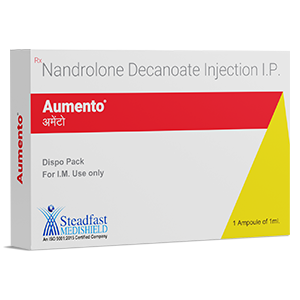
For the use of a Registered Medical Practitioner, Hospital or Laboratory only.
1. Description
Aumento is a high dosage form of Nandrolone Decanoate, designed especially for adjuvant therapy in the treatment of certain blood disorders. Nandrolone, the pharmacologically active substance of the preparation, is chemically related to the male hormone. Compared to testosterone, it has an enhanced anabolic and reduced androgenic activity.
Aumento stimulates erythropoiesis as demonstrated by the rise in the red blood cell mass and the haemoglobin and haematocrit values. This effect is utilized therapeutically in the treatment of anaemia due to a decreased production of erythropoietin, bone marrow depression induced by chemotherapy or hypoplasia of the stem cells in the bone marrow. In the latter condition (e.g. aplastic anaemia), the erythropoietic response is frequently accompanied by a positive on leucopoiesis and thrombopoiesis. Androgenic effects (e.g. virilisation), are relatively uncommon at the recommended dosages. Nandrolone lacks the C17 alpha-alkyl group, which is associated with the occurrence of liver dysfunction and cholestasis.
2. Composition
Each mL of Aumento contains 100 mg Nandrolone Decanoate I.P. in an oily base
3. Dosage Form
Solution for injection
4. Pharmacology
Pharmacodynamics
Mechanism of action
After intramuscular administration, nandrolone binds to intracellular androgen receptors in skeletal muscle, bone, and other target tissues.
The drug–receptor complex translocates to the nucleus and regulates gene transcription, resulting in increased protein synthesis.
It promotes nitrogen retention and reduces protein breakdown, leading to positive nitrogen balance.
Stimulates erythropoiesis by increasing erythropoietin production and enhancing bone marrow activity, thereby increasing haemoglobin and red blood cell production.
Increases bone mineral density by promoting osteoblastic activity and calcium deposition, making it useful in osteoporosis.
Enhances appetite and improves lean body mass.
Pharmacokinetics
Absorption
Administered by deep intramuscular injection.
The decanoate ester forms a depot at the injection site, from which nandrolone is slowly released.
Distribution
Widely distributed to androgen-responsive tissues.
Approximately 50–60% bound to plasma proteins.
Metabolism
The decanoate ester is hydrolysed to free nandrolone.
Nandrolone is metabolised primarily in the liver to inactive metabolites.
Elimination
Metabolites are excreted mainly in the urine, with a small proportion eliminated in the faeces.
The apparent elimination half-life after intramuscular administration is approximately 6–12 days, allowing dosing every 2–4 weeks depending on the indication.
5. Indications
- Anaemia of chronic renal failure
- Aplastic Anaemia
- Anaemia due to cytotoxic therapy
6. Contraindications
- Pregnancy
- Known or suspected carcinoma of the prostate or breast in the male
Use during pregnancy and breastfeeding: This medicine is contraindicated during pregnancy because of the possible masculinization of the fetus. There are insufficient data on the use of the medicine during breastfeeding to assess potential harm to the infant or a possible influence on milk production.
7. Precautions
The recommended dosage should not be exceeded.
Prohibited in competitive sport (WADA).
If signs of virilisation develop, discontinuation of the treatment should be considered, preferably in consultation with the patient.
It is recommended to monitor patients with any of the following conditions:
- Latent or overt cardiac failure, renal dysfunction, hypertension or migraine (or a history of these conditions), since anabolic steroids may occasionally induce fluid retention.
- Incomplete stature growth, since anabolic steroids in high dosages may accelerate epiphyseal closure.
- Skeletal metastases of breast carcinoma. In these patients, hypercalcaemia may develop both spontaneously and as a result of anabolic steroid therapy. The latter can be indicative of a positive tumour response to the hormonal treatment. Nevertheless, the hypercalcaemia should first be treated properly and after restoration of normal calcium levels, hormone therapy can be resumed.
- Liver dysfunction
- The use of anabolic steroids to enhance athletic ability may carry severe risks to the user’s health and should be discouraged.
8. Drug Interactions
Anabolic Steroids may improve glucose tolerance and decrease the need for insulin or other anti-diabetic medicines in diabetes.
Although only one possible case of interaction with an oral anti-coagulant has been observed, it is advisable to check the prothrombin time regularly when Aumento is used in patients on anticoagulant therapy.
9. Adverse Effects
The high dosages, which are required to obtain a therapeutic effect in the indications, may cause:
- Virilisation, which appears in sensitive women as hoarseness, acne, hirsutism and increase of libido; in pre-pubertal boys as an increase in the frequency of erections and phallic enlargement and in girls as an increase of pubic hair and clitoral hypertrophy. Hoarseness may be the first symptom of vocal change which may end in a long-lasting, sometimes irreversible, deepening of the voice.
- Amenorrhea
- Inhibition of spermatogenesis
- Premature epiphyseal closure
- Fluid retention
- Occasional, abnormal values in some liver function tests. These changes appear to be reversible after completion of treatment of the course.
10. Dosage & Administration
- Anaemia of chronic renal failure – Males: 200 mg every week, Females: 100 mg every week.
- Aplastic Anaemia – 50-150 mg every week.
- Anaemia due to cytotoxic therapy – 200 mg every week, starting 2 weeks prior to the course of cytotoxic therapy. This treatment should be continued throughout cytotoxic therapy and thereafter during the recovery period until the blood count has returned to normal.
Aumento should be administered by deep intramuscular injection.
N.B.
- Treatment with Aumento does not substitute for other therapeutic measures.
- The onset of a therapeutic effect may vary widely among patients. If no satisfactory response occurs after 3-6 months of treatment, administration should be discontinued.
- After a satisfactory improvement or a normalisation of the red blood picture has been obtained, treatment should be withdrawn gradually on the basis of regular monitoring of the haematological parameters. Should a relapse occur at any time whilst the dose is being reduced or after stopping the treatment, re-institution of therapy should be considered.
- A dosage scheme for children cannot be given because of insufficient clinical experience.
11. Overdosage
The acute toxicity of Nandrolone Decanoate in animals is very low. There are no reports of acute overdosage with Aumento in humans.
12. Storage
Keep in a dry place away from light.
13. Presentation
Aumento is available as 1 mL ampoule along with sterile disposable syringe packed in a blister as disposable pack.