
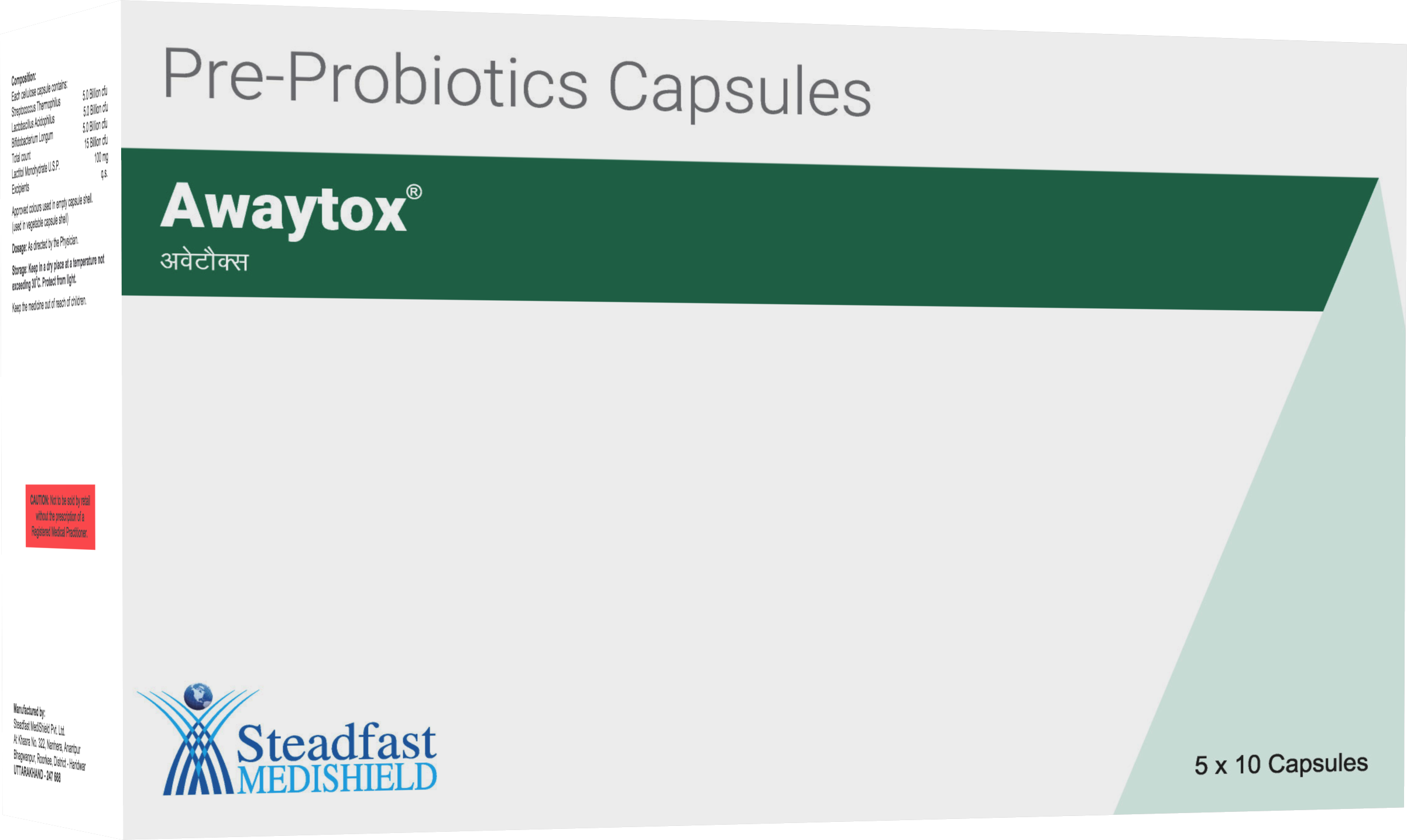
For the use of a Registered Medical Practitioner, Hospital or Laboratory only.
1. Description
Awaytox is a Pre-Probiotic combination, a blend of probiotic Lactobacillus and Bifidobacterium species, the two most important genera associated with the human intestinal tract and oral adsorbent Lactitol monohydrate.
Patients with chronic disease have abnormal microbiota when compared to healthy individuals. Diet and impaired protein absorption, increased intestinal transit time, medications, and uraemia may all contribute to unfavorable changes in microbiota. Probiotic is used to maintain a friendly bacterial balance for support to healthy digestion. Probiotics may help reduce gut-derived uraemic toxins in CKD patients and in patients undergoing dialysis.¹⁻³
2. Composition
| Ingredient | Count / Quantity |
| Bifidobacterium longum | 5 Billion CFU |
| Lactobacillus acidophilus | 5 Billion CFU |
| Streptococcus thermophilus | 5 Billion CFU |
| Total Count | 15 Billion CFU |
| Lactitol monohydrate USP (Prebiotic) | 100 mg |
3. Dosage Form
Capsule
4. Pharmacology
Pharmacodynamics
The probiotic bacteria colonise the intestine and help restore a healthy gut microbiota.
FOS (Fructo-oligosaccharides) acts as a prebiotic, promoting the growth and activity of beneficial bacteria.
The probiotics metabolise nitrogenous waste products that diffuse from the bloodstream into the intestinal lumen.
This reduces the intestinal generation and absorption of uraemic toxins (such as ammonia and other nitrogenous compounds), thereby decreasing the systemic toxin burden.
Improvement in gut microbial balance may reduce inflammation, improve intestinal barrier function, and support gastrointestinal health.
In CKD patients, these effects may contribute to lower blood urea and help slow the accumulation of uraemic toxins when used as part of standard therapy.
Awaytox Pre-Probiotic is a blend of probiotic Lactobacillus and Bifidobacterium species, the two most important genera associated with the human intestinal tract and oral adsorbent Lactitol monohydrate. Each capsule supplies 15 billion active cells, otherwise called colony forming units (CFU).
Lactobacillus acidophilus 5 billion CFU: Studies have shown that dialysis patients, who were given freeze-dried Lactobacillus acidophilus, have reduced concentration of toxins (methylamine, dimethylamine, nitrosamines and several other carcinogenic amines) in the bloodstream. In addition, it also helps to prevent the growth of pathogenic bacteria in the small bowel.
Bifidobacterium longum 5 billion CFU: These bacteria utilize various phenolic and indole metabolic toxic compounds in the colonic region as its nutrients for growth.
Streptococcus thermophilus 5 billion CFU: This bacterium actually utilizes urea/Creatinine/uric acid as nutrients for its increased growth and survival and thus help cleanse the bloodstream of urea and uric acid.
Pharmacokinetics
Awaytox contains live probiotic microorganisms rather than a conventional drug, classical pharmacokinetic parameters (absorption, distribution, metabolism, and elimination) are not fully applicable.
Absorption: The probiotic organisms are not systemically absorbed. They survive passage through the gastrointestinal tract and exert their effects locally in the intestine.
Distribution: The microorganisms transiently colonise the gastrointestinal tract without significant systemic distribution.
Metabolism: The bacteria ferment dietary carbohydrates and FOS, producing short-chain fatty acids such as acetate, and lactic acid, while metabolising nitrogenous compounds in the gut.
Elimination: The probiotic organisms are gradually excreted in the faeces after their transient residence in the intestine. Their persistence depends on continued administration and the individual’s gut microbiota.
5. Indications
Awaytox may help reduce gut-derived uraemic toxins in chronic kidney disease (CKD).¹⁻³
6. Contraindications
- Known hypersensitivity to any of the probiotic strains, the prebiotic or any excipient.
- Intestinal obstruction.
- Severe immunocompromised states (e.g., profound neutropenia), unless prescribed and closely monitored by a physician.
7. Precautions
- Use under medical supervision in immunocompromised, critically ill or hospitalised patients and in patients with central venous catheters.
- Transient flatulence, bloating or abdominal discomfort may occur during the first few days of therapy due to fermentation of the prebiotic.
- Administer at least 2–3 hours apart from antibiotics.
- Discontinue and seek medical advice if persistent diarrhoea, fever or signs of systemic infection develop.
8. Drug Interactions
Probiotics used too soon after an antibiotic dosing could result in a loss of antibiotic efficacy. Follow standard pharmacy recommendations for dosing separation of probiotic and antibiotic substances.
Probiotic gains in friendly bacteria populations will be reduced by antibiotic therapy. Patients should be encouraged to support and maintain probiotic populations during and after an antibiotic course.
9. Adverse Effects
Probiotic bacteria are indigenous to the human intestinal tract and their introduction into the alimentary tract is not associated with adverse side effects or considered a risk to health.
The daily recommended dose, or exceeding the recommended daily dose, may cause irritation and possibly a change in stool characteristics. Dose adjustments will resolve overuse problems.
10. Dosage & Administration
The recommended dosage of Awaytox in CKD is 1-2 capsules with every meal. The dose should be adjusted to suit the requirements of the individual patients.
11. Overdosage
No data available.
12. Storage
Store in a dry place at a temperature not exceeding 30°C. Protect from light. Keep the medicine out of reach of children.
Additional Information
Evidence summary
Evidence summary: In a 6-month randomised, placebo-controlled crossover pilot study in CKD stage 3–4 using the same three strains (S. thermophilus KB19, L. acidophilus KB27, B. longum KB31), blood urea nitrogen fell in 63% of patients.¹ A 2-month trial in haemodialysis patients showed no statistically significant change in uraemic toxins.² A systematic review found limited but supportive evidence that pre- and probiotics lower p-cresyl sulfate and indoxyl sulfate in CKD.³
13. Presentation
10 capsules in a strip, 5 strips in a Box.
References
- Ranganathan N, Ranganathan P, Friedman EA, et al. Pilot study of probiotic dietary supplementation for promoting healthy kidney function in patients with chronic kidney disease. Adv Ther. 2010;27(9):634–647. doi:10.1007/s12325-010-0059-9
- Natarajan R, Pechenyak B, Vyas U, et al. Randomized controlled trial of strain-specific probiotic formulation (Renadyl) in dialysis patients. Biomed Res Int. 2014;2014:568571. doi:10.1155/2014/568571
- Rossi M, Klein K, Johnson DW, Campbell KL. Pre-, pro-, and synbiotics: do they have a role in reducing uremic toxins? A systematic review and meta-analysis. Int J Nephrol. 2012;2012:673631. doi:10.1155/2012/673631