
For the use of a Registered Medical Practitioner, Hospital or Laboratory only.
1. Description
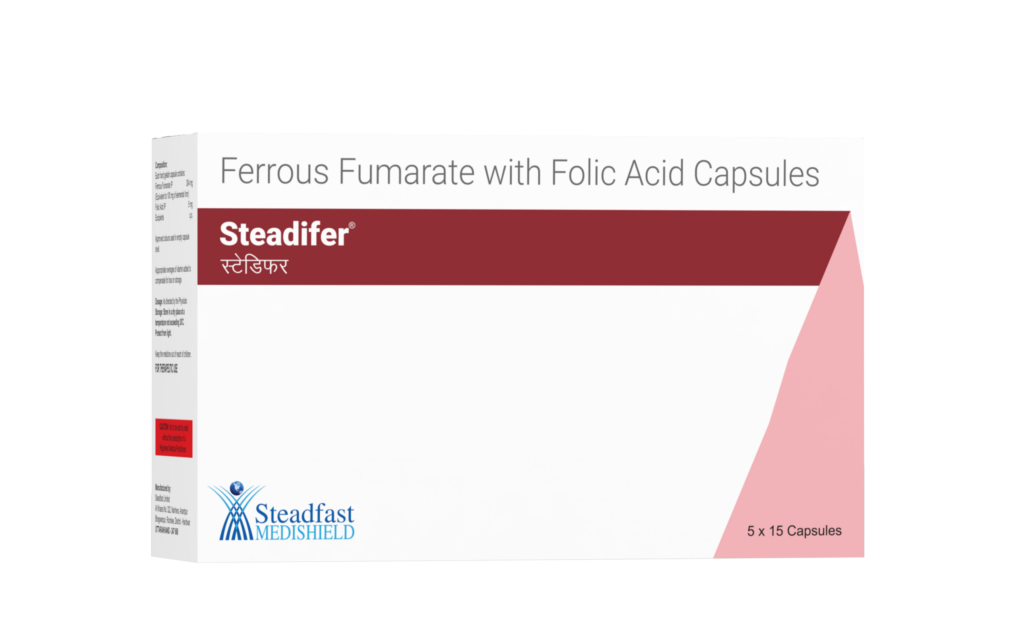
Steadifer is a combination of Ferrous Fumarate and Folic Acid, which is specially designed to treat iron deficiency anaemia in certain specific conditions.
2. Composition
Each hard gelatin capsule contains:
- Ferrous Fumarate IP 304 mg (equivalent to 100 mg of elemental iron)
- Folic Acid IP – 5 mg
- Excipients – q.s.
Approved colours used in empty capsule shell. Appropriate overages of vitamin added to compensate for loss on storage.
Steadifer is a haematinic preparation used for the prevention and treatment of iron deficiency anaemia and folate deficiency.
3. Dosage Form
Hard gelatin capsule
4. Pharmacology
Pharmacodynamics
Steadifer combines ferrous fumarate, a source of elemental iron, with folic acid, an essential vitamin required for DNA synthesis and erythropoiesis.
Ferrous Fumarate
Ferrous fumarate supplies elemental iron, which is absorbed in the small intestine and incorporated into haemoglobin, myoglobin, and iron-containing enzymes.
Iron is essential for oxygen transport, cellular respiration, and normal red blood cell production.
Replenishment of iron stores corrects iron deficiency and restores normal haemoglobin synthesis.
Folic Acid
Folic acid is converted to tetrahydrofolate, the biologically active form required for DNA and RNA synthesis.
It promotes normal maturation of erythrocyte precursors in the bone marrow and prevents megaloblastic anaemia.
Folic acid also helps reduce elevated homocysteine levels by participating in one-carbon metabolism.
Pharmacokinetics
Absorption
Ferrous fumarate is absorbed primarily in the duodenum and proximal jejunum. Iron absorption is enhanced when body iron stores are low and may be increased by vitamin C, while food, calcium, antacids, and phytates can reduce absorption.
Folic acid is rapidly absorbed from the proximal small intestine, with high oral bioavailability under normal physiological conditions .
Distribution
Absorbed iron binds to transferrin in plasma and is transported mainly to the bone marrow for haemoglobin synthesis. Excess iron is stored as ferritin and haemosiderin in the liver, spleen, and bone marrow.
Folic acid is distributed throughout body tissues, particularly the liver and rapidly dividing cells, and crosses the placenta.
Metabolism
Iron is not metabolised. It is incorporated into haemoglobin, myoglobin, and various enzymes or stored in ferritin and haemosiderin.
Folic acid is converted in the liver and other tissues to active tetrahydrofolate derivatives, which participate in nucleic acid synthesis and amino acid metabolism.
Elimination
Iron has no active excretory pathway. Approximately 1–2 mg/day is lost through the shedding of intestinal epithelial cells, skin, sweat, urine, and menstrual blood in women. Homeostasis is primarily regulated by intestinal absorption rather than excretion.
Excess folate and its metabolites are eliminated mainly in the urine, with a small amount excreted in the faeces.
5. Indications
Steadifer is indicated in the treatment and maintenance of:
- Iron deficiency anaemia
- Megaloblastic anaemia of nutritional origin
- Anaemia of pregnancy
- Other anaemias deemed responsive to the ingredients
6. Contraindications
Steadifer is contraindicated in patients with proven allergy to any ingredient, symptoms of iron intolerance, paroxysmal nocturnal haemoglobinuria, haemosiderosis and haemochromatosis.
7. Precautions
Warning: Steadifer alone should not be relied upon for correction of isolated folic acid deficiency and specific therapy should be instituted in these cases. Cases not responding satisfactorily to Steadifer should be investigated for sites of continued blood loss or other causes of apparent haematinic failure.
Avoid use in patients with active peptic ulcers, repeated blood transfusion, regional enteritis and ulcerative colitis. Caution when used in patients with folate-dependent tumours.
8. Drug Interactions
Concurrent administration may reduce the efficacy of fluoroquinolones, levodopa, carbidopa, thyroxine and biophosphates. Iron may reduce the absorption of penicillamine by forming complexes. Concurrent administration may lead to reduced absorption of tetracycline and iron. Antacids may reduce the absorption of iron. Serum levels of anticonvulsants may be reduced by folic acid.
9. Adverse Effects
As with all orally administered iron salts, Steadifer may cause gastric irritation, dyspepsia, anorexia nausea, vomiting, constipation etc in sensitive individuals. Stool darkening may occur. Allergies to folic acid have been reported.
10. Dosage & Administration
As directed by the physician. Do not take more than the recommended dosage.
Take Steadifer on an empty stomach, at least 1 hour before or 2 hours after a meal. Avoid taking antacids or antibiotics within 2 hours before or after. If upset stomach occurs, you may take this medication with food. Avoid taking antacids, dairy products, tea or coffee within 2 hours before or after this medication because they will decrease its effectiveness. Do not lie down for 30 minutes after taking this medication. Do not crush, chew or break the capsule. Doing so can destroy the long action of the drug and may increase side effects.
11. Overdosage
Symptoms of overdosage can be any of those described under “Precautions” and “Adverse Effects” above. If any symptoms of intolerance occur, the drug should be temporarily or permanently discontinued.
12. Storage
Store in a dry place at a temperature not exceeding 30°C. Protect from light. Keep the medicine out of reach of children.
Additional Information
Additional pharmacology information
Ferrous fumarate provides elemental iron in a well-tolerated form, specifically to meet iron requirements of the red blood cell formation and building of tissue iron stores. The dosage of iron recommended for prevention and control of iron deficiency anaemia is 100 mg elemental iron.
Ferrous fumarate is used to treat iron deficiency anaemia (lack of red blood cells caused by having too little iron in the body). Ferrous fumarate is a type of iron. In the body, iron becomes a part of haemoglobin and myoglobin. Haemoglobin carries oxygen through blood to the tissues and organs. Myoglobin helps the muscle cells store oxygen.
Folic acid is a member of the Vitamin B group. Folic acid is reduced in the body to tetrahydrofolate, which is a coenzyme for various metabolic processes including the synthesis of purine and pyrimidine nucleotides and hence, in the synthesis of DNA. Deficiency of folic acid can result in megaloblastic anaemia.
Folic acid supplementation prevents adverse events in individuals with chronic kidney disease and end-stage renal disease. Folic acid remains the cornerstone therapy for elevated homocysteine. Patients with renal failure often require high doses. No risks have been reported with the use of folic acid. Administration of high dosage folic acid (5 mg/day) lowers homocysteine by 25% sufficient to normalize levels.
13. Presentation
15 capsules in a strip, 5 strips in a Box.