
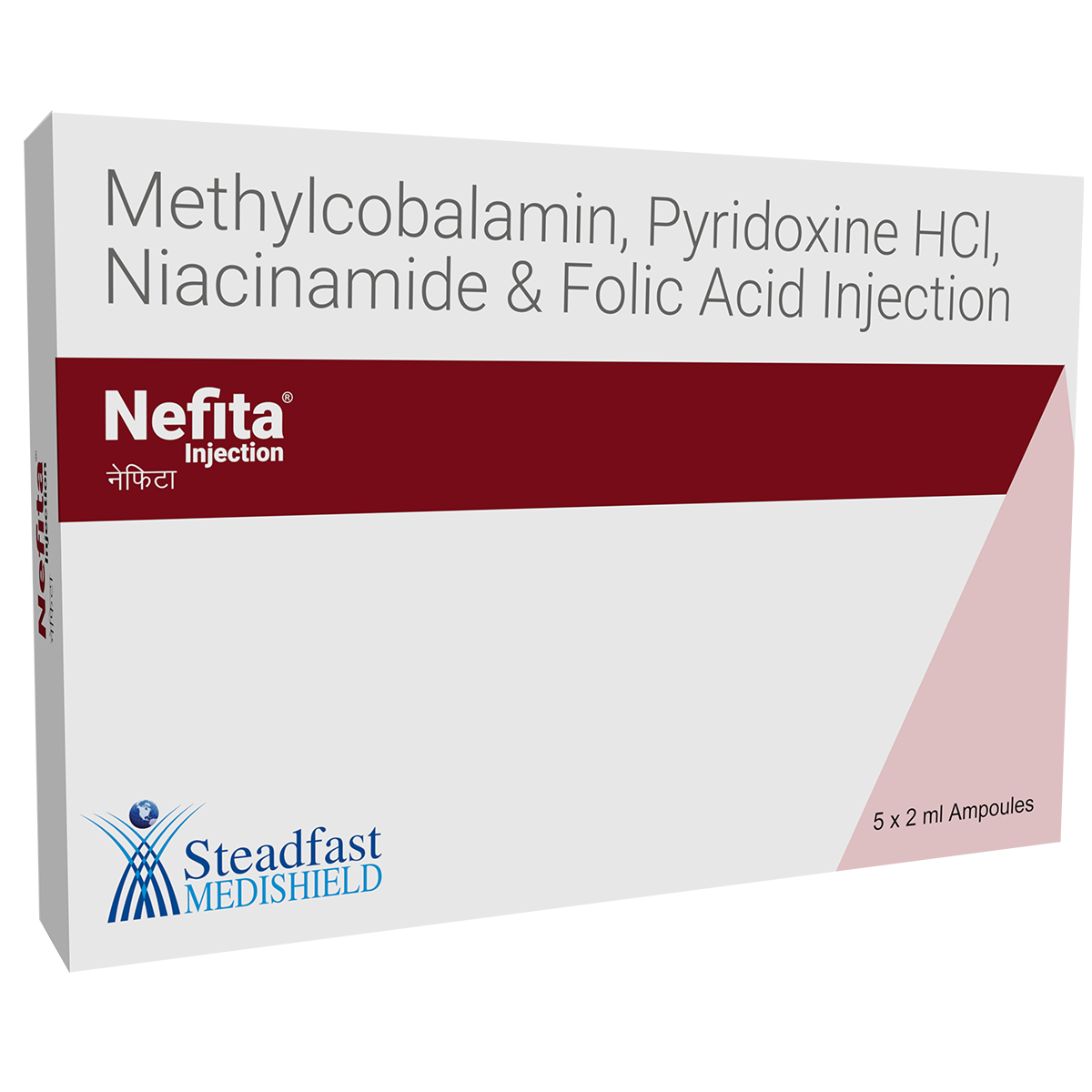
For the use of a Registered Medical Practitioner, Hospital or Laboratory only.
1. Description
Nefita injection is a multi-vitamins formulation specifically designed to suit the nutritional needs of patients of kidney disease and/or on dialysis treatment. The need of the injection arises just after a dialysis procedure is done to a patient. The need of medication is so as to correct or fulfill the immediate requirement of vitamins in the body that will lose during a dialysis.
Nefita injection has developed considering a very special need and to avoid deficiency of vital nutrients.
Nefita Injection is a well thought and researched composition that has a high scope and extent considering the use after each dialysis session.
In patients with kidney failure, heart attacks occur 5–10 times more than in the general population. More than 90% of dialysis patients have high homocysteine levels. By taking adequate amounts of folic acid and vitamins B12 and B6, the risk for heart disease may decrease by 20%–55%.
2. Composition
Each 2 mL contains:
- Methylcobalamin IP – 1500 mcg
- Pyridoxine HCl IP – 100 mg
- Niacinamide IP – 100 mg
- Folic Acid IP – 1.5 mg
- Benzyl Alcohol IP – 2% v/v (as preservative)
- Water for Injection IP – q.s.
Appropriate overages of vitamins are added to compensate loss on storage.
3. Dosage Form
Injection — for IV or IM use
4. Pharmacology
Nefita Injection is a combination of Vitamins endowed with a particular hepato-protective activity in an optimal ratio so as to attain maximum therapeutic synergy. It also acts at a level of bone marrow to stimulate erythropoiesis. Methylcobalamin has a complex biological activity and takes part in protein synthesis particularly in neuronal and hepatic tissues.
Pharmacodynamics
Nefita Injection is a combination of Methylcobalamin, Folic Acid, Pyridoxine Hydrochloride, and Niacinamide, formulated to replenish water-soluble vitamin deficiencies, particularly in patients with chronic kidney disease (CKD) and those undergoing dialysis. It supports erythropoiesis, nerve function, and cellular metabolism.
Methylcobalamin (Vitamin B12) acts as the active coenzyme form of vitamin B12 and is essential for DNA synthesis, red blood cell maturation, and maintenance of myelin, thereby supporting nerve regeneration and neurological function.
Folic Acid (Vitamin B9) is required for nucleic acid synthesis and normal erythropoiesis. Together with vitamin B12, it promotes the formation of healthy red blood cells and helps reduce elevated homocysteine levels.
Pyridoxine (Vitamin B6) functions as a coenzyme in amino acid metabolism, neurotransmitter synthesis, and heme synthesis, thereby supporting haemoglobin production and normal nervous system function.
Niacinamide (Vitamin B3) is a precursor of NAD and NADP coenzymes, which are essential for cellular energy production, carbohydrate, fat, and protein metabolism, and numerous oxidation-reduction reactions.
Pharmacokinetics
Absorption
Nefita Injection is administered by intramuscular (IM) or intravenous (IV) injection, thereby bypassing gastrointestinal absorption.
Following IM administration, the vitamins are rapidly absorbed into the systemic circulation, while IV administration provides immediate systemic availability.
Distribution
Methylcobalamin is extensively distributed to the liver, bone marrow, and nervous tissue, with significant hepatic storage.
Folic acid is distributed to rapidly dividing tissues and crosses the placenta.
Pyridoxine is widely distributed throughout body tissues and is converted to its active coenzyme form, pyridoxal-5-phosphate.
Niacinamide is distributed widely and enters cells where it is incorporated into NAD and NADP coenzymes.
Metabolism
Methylcobalamin functions directly as an active coenzyme and undergoes enterohepatic recycling.
Folic acid is converted to tetrahydrofolate derivatives, which participate in one-carbon transfer reactions essential for DNA synthesis.
Pyridoxine is metabolised in the liver to the active metabolite pyridoxal-5-phosphate (PLP).
Niacinamide is metabolised in the liver to inactive methylated metabolites after participating in cellular metabolic pathways.
Elimination
Water-soluble vitamins are eliminated primarily through the kidneys.
Excess methylcobalamin is excreted in the urine, although a significant portion is retained in the liver.
Folate, pyridoxine metabolites, and niacinamide metabolites are excreted predominantly in the urine.
In patients with renal impairment, elimination of some vitamins may be reduced, and dosing should follow the treating physician’s recommendation.
5. Indications
- Vitamin B12 Deficiency
- Anaemia
- Hyperhomocysteinaemia
- Uraemic Neuropathy
- Liver Disorders
- Megaloblastic Anaemia
- Pre & Post Surgery
- In all ages – Infections, General Debility, Weakness
Depending on the level and type of Anaemia, Nefita injection is indicated for the following conditions:
- Mild Anaemia
- Moderate Anaemia
- Post blood profusion maintenance of haemoglobin
- Chronic or Severe anaemia
6. Contraindications
Not to be used in newly born or premature infants.
7. Precautions
The injection should be discarded if visible particles appear.
8. Drug Interactions
- Folic acid may reduce serum levels of phenytoin, phenobarbital and primidone; methotrexate, pyrimethamine and trimethoprim antagonise folic acid.
- Pyridoxine may reduce the effect of levodopa given without carbidopa and may lower phenytoin and phenobarbital levels.
- Chloramphenicol may impair the haematological response to vitamin B12.
9. Adverse Effects
Generally well tolerated. Pain or irritation at the injection site, mild diarrhoea, nausea, headache, flushing (niacinamide) and pruritus may occur. Hypersensitivity reactions including rash and, rarely, anaphylaxis have been reported with parenteral vitamin B12.
10. Dosage & Administration
IM (Intramuscular)
- Routine Antenatal Care: Once a week, Stop if Hb is > 13 g/dl and recommence if Hb < 11 g/dl
- Mild Anaemia: Once/Twice a week
- Severe Anaemia: Alternate days till the Hb improves
- Post-Dialysis: One ampoule after each dialysis followed by Nefita tabs once daily (except on the day of dialysis)
IV (Intravenous)
Dosage same as for intramuscular but should be mixed with 500 mL of infusion and given over 2 hours
11. Overdosage
Overdose symptoms may include stomach pain, vomiting, diarrhoea, constipation, loss of appetite, hair loss, peeling skin, tingly feeling in or around your mouth, changes in menstrual periods, weight loss, severe headache, muscle or joint pain, severe back pain, blood in your urine, pale skin, and easy bruising or bleeding.
12. Storage
Store in a cool, dry & dark place. Keep the medicine out of reach of children.
Additional Information
Role of Nefita Injection in Dialysis Patients
Methylcobalamin in Dialysis
- Methylcobalamin helps make new cells, maintains nerve cells, works with folic acid to make red blood cells
- Neuropathy is found in 65% of patients on or nearing dialysis when GFR falls below 10%. Uraemic neuropathy is an important cause of morbidity among patients undergoing chronic haemodialysis. Methylcobalamin is a safe and potentially beneficial therapy for neuropathy in Chronic HD patients
Nicotinamide in Dialysis
- Niacinamide helps the body use sugars and fatty acids, helps cells produce energy and helps enzymes function in the body
- It provides an interesting therapeutic approach to both Hyperphosphataemia and low HDL levels in dialysis patients. Low HDL, type 2 diabetes, and progressive atherosclerosis are important issues contributing to morbidity and mortality of dialysis patients. Findings indicate that Niacinamide significantly increased the HDL values in dialysis patients
Pyridoxine in Dialysis
- Pyridoxine helps the body make protein, which is then use to make cells
- Helps make Red Blood Cells
Folic Acid in Dialysis
- Folic Acid helps make DNA for new cells, works with Methylcobalamin to make red blood cells
- Hyperhomocysteinaemia occurs in renal failure and may increase the risk for cardiovascular disease
- Peritoneal dialysis patients have Hyperhomocysteinaemia, which can be normalized with folic acid alone in about 40% of patients
- A maintenance dose of 1 or 5 mg folic acid daily results in equivalent plasma homocysteine levels
CKD Recommendation
| Vitamin | Recommendation |
| Methylcobalamin (Vit-B12) | 2-3 mcg/day supplement for CKD patient, always include B12 with Folic acid |
| Folic Acid | 1 mg/day supplement for CKD patients |
| Niacinamide | 14-20 mg/day supplement for CKD patients (Dialysis and Non-dialysis) |
| Pyridoxine HCl | 5/ 10 mg/day supplement for CKD patients (non-dialysis/ dialysis) |
Pyridoxine: 50 mg/day when prescribed with folic acid and vitamin B12 to reduce homocysteine levels. Large doses (200 mg/day) over long period can cause nerve damage.
13. Presentation
5 ampoules of 2 mL each in a Box.