
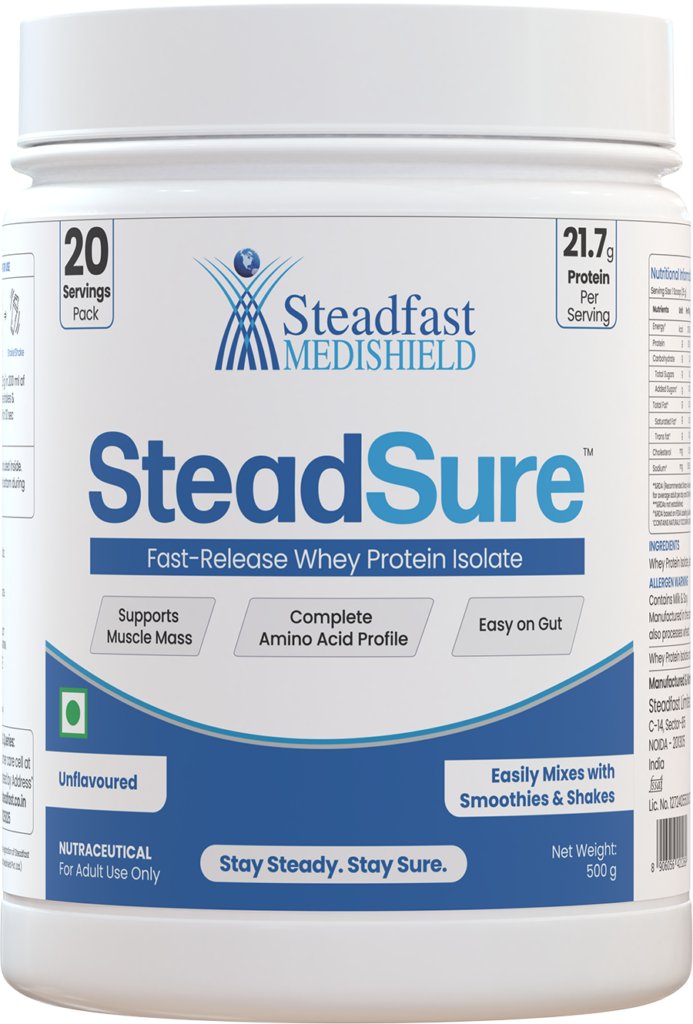
SteadSure is a whey protein isolate–based formulated to support lean muscle and strength preservation in patients undergoing GLP-1 receptor agonist (GLP-1 RA) therapy for type 2 diabetes or weight management. GLP-1 RAs (semaglutide, liraglutide, tirzepatide, dulaglutide) work through appetite suppression and delayed gastric emptying — effective for fat loss, but a disproportionate share (roughly 25–40%) of the weight lost on these therapies can come from lean, not fat, mass, compared with 20–25% on diet-only weight loss.SteadSure is designed to sit alongside GLP-1 RA prescriptions as a nutritional safeguard against this lean-mass loss. SteadSure also supports a second, mechanistically distinct population: patients with dialysis-dependent chronic kidney disease (haemodialysis or peritoneal dialysis), who lose protein directly through dialysis and require elevated — not restricted — protein intake under nephrologist/renal dietitian guidance.
Composition
Each 25 g serving (1 levelled scoop) of SteadSure Whey Protein Isolate (Unflavoured) provides approximately 21.7 g protein, including 11.3 g essential amino acids (EAAs) and 5.29 g branched-chain amino acids (BCAAs). Contains Whey Protein Isolate and Lecithin.
Pharmacology
Mechanism / Rationale
SteadSure is formulated with whey protein isolate, chosen for its high leucine density, rapid gastric clearance, high protein yield per unit volume, and complete essential amino acid profile. These properties make it suited to individuals with reduced appetite or food volume tolerance — including patients on GLP-1 receptor agonist (GLP-1 RA) therapy, who commonly lose a disproportionate share of lean (fat-free) body mass during rapid weight loss. A second, distinct mechanism applies to dialysis-dependent patients: dialysis itself is protein-catabolic — haemodialysis removes approximately 6–8 g of amino acids/protein per session, and peritoneal dialysis causes continuous protein loss into the dialysate — placing these patients at elevated risk of protein-energy wasting (PEW) independent of appetite or GLP-1 RA use.
Pharmacodynamics
- Leucine density: whey isolate provides the highest leucine concentration of any common protein source, the key amino acid trigger for muscle protein synthesis (MPS).
- A serving supplying 2.43 g of leucine is generally considered sufficient to maximally stimulate Muscle Protein Synthesis (MPS); whey isolate reaches this threshold at a lower total protein dose than most alternative sources.
- Fast absorption and low gastric residence time reduce the digestive burden associated with delayed gastric emptying (a mechanism of action of GLP-1 RA therapy).
- Complete essential amino acid profile supports muscle repair rather than nitrogen supply alone.
- Favourable phosphorus-to-protein ratio relative to whole-food and concentrate protein sources — a relevant consideration for patients managing mineral load, including those with dialysis-dependent CKD.
Pharmacokinetics (Digestion & Absorption Profile)
As a fast-digesting protein, whey isolate produces a rapid rise in circulating plasma amino acid levels, typically peaking within 60–90 minutes of ingestion, with lactose and fat content minimised relative to whey concentrate to support tolerability and faster gastric clearance.
Indications
- Adjunctive protein supplementation in patients on GLP-1 receptor agonist therapy (oral or injectable) undergoing rapid weight loss, where preservation of lean mass is a clinical concern.
- Nutritional support for the maintenance of lean muscle mass in adults with reduced or inadequate dietary protein intake.
- Adjunctive protein supplementation in patients with dialysis-dependent chronic kidney disease (haemodialysis or peritoneal dialysis) to help meet elevated, guideline-directed protein intake (KDOQI 2020: 1.0–1.2 g/kg/day) and address protein-energy wasting (PEW), under Nephrologist/Renal Dietitian supervision.
Contraindications
- Known hypersensitivity to milk protein (whey) or soy (lecithin).
- Not intended for infants, young children, pregnant or lactating women unless advised by a physician.
Precautions
- For adult use only.
- Not a substitute for a balanced diet; use as part of an overall nutrition plan.
- Dialysis-dependent CKD (haemodialysis or peritoneal dialysis): SteadSure may help meet elevated, guideline-directed protein targets, but should be used only under the guidance of the treating Nephrologist/Renal Dietitian, with individualised dosing and monitoring.
- Non-dialysis CKD (Stages 1–5, not on dialysis): standard clinical guidelines recommend protein restriction, not supplementation, in this population. SteadSure should not be used without explicit physician direction, as general protein targets do not apply.
- Manufactured in a facility that also processes wheat; individuals with wheat/gluten sensitivity should exercise caution.
Drug Interactions
No clinically significant drug interactions have been established for whey protein isolate. As a general precaution, patients receiving oral GLP-1 receptor agonists, which require a strict post-dose fasting period, should consume whey protein outside this fasting window. Patients receiving once-weekly injectable GLP-1 receptor agonists may prefer to concentrate their protein intake after the acute post-injection nausea period has resolved.
Adverse Effects
- Rare hypersensitivity reactions in individuals allergic to milk or soy.
Overdosage
Excessive protein intake beyond individual requirement may increase renal solute load and, in individuals with pre-existing renal impairment, should be avoided except under physician guidance. In the general population, intake substantially above recommended servings may cause gastrointestinal discomfort. There is no specific antidote; management is supportive.
Dosage and Administration
Recommended usage: 2 servings daily for adults, or as directed by a physician/dietitian.
Mix 1 levelled scoop (25 g) in 200 ml of water, or a beverage/shake of choice, and shake well for 30 seconds before consuming. Smaller, more frequent servings (approx. 15–20 g) may be preferred over larger single servings in patients with reduced gastric tolerance (e.g., on GLP-1 RA therapy).
For patients with dialysis-dependent CKD, dosing should follow the individualised protein target set by the treating Nephrologist/Renal Dietitian rather than the standard adult recommendation above.
Storage
Store in a cool and dry place.
Presentation
500 g pack (20 servings of 25 g each), Unflavoured.